A walk on the cosmic shoreline

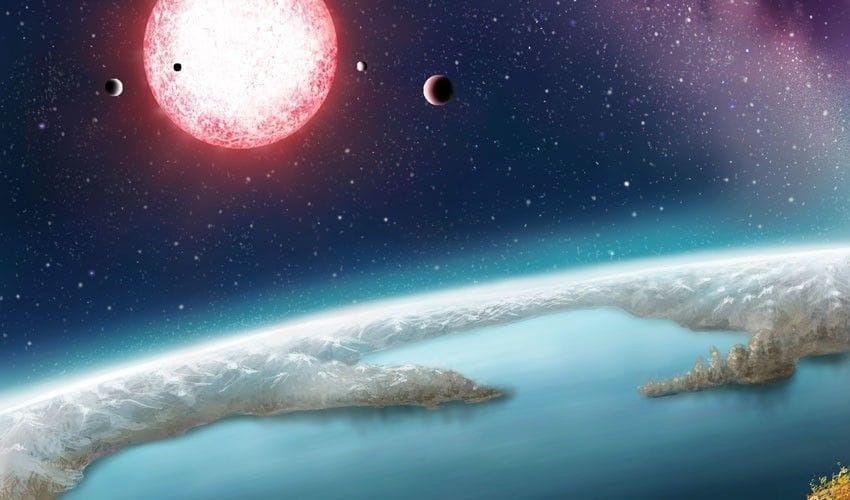
Thanks for tuning back into the BeX Files! Put on your space sandals and warm up your muscles, because we are taking a long walk on the cosmic shoreline today.
Last week, scientists reported the discovery of the first atmosphere ever spotted around a rocky exoplanet in the habitable zone of its star, which is a major milestone in the search for extraterrestrial life. The story, which I covered for 404 Media, offers a glimpse of a world that has all the essential ingredients for life as we know it on Earth, including a rocky crust, an atmosphere, and the potential to host liquid water.
 Becky Ferreira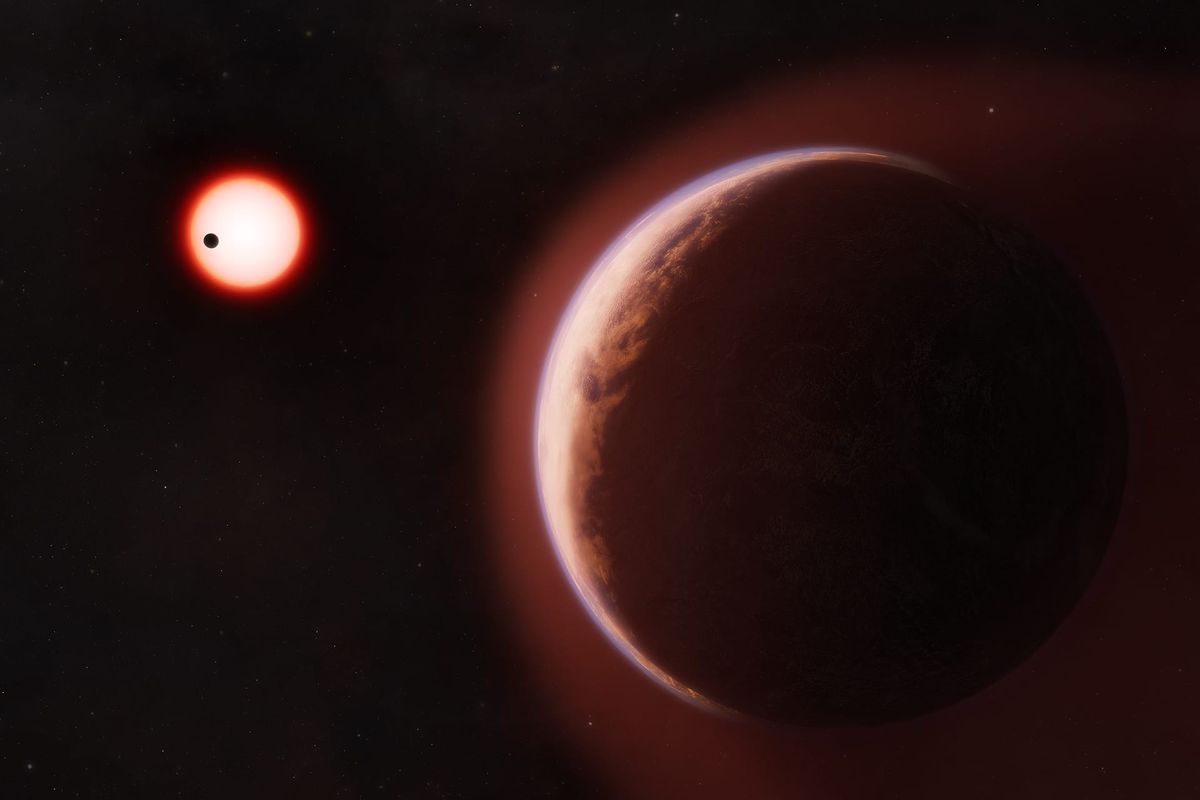
The exoplanet, known as LHS 1140-b, is five times more massive than Earth and orbits a red dwarf star about 48 light years from our solar system. Scientists led by Collin Cherubim, a NASA Hubble Fellow at the University of Chicago, were able to directly spot helium escaping from the skies of this world, an observation that suggests it belongs to a new class of planets with unique chemistry and the potential to host life.
“I think this is the best place to be looking for biosignatures,” Cherubim told me. “We're really excited to see what comes out of that.”
In addition to the breakthrough discovery of these tantalizing skies, the study also offers insights into what’s known as the “cosmic shoreline,” which is the dividing line between planets that can hold onto long-lived atmospheres from those that lose their atmospheres to space, or never form them in the first place.
Before they even observed this star system, Cherubim’s team predicted that LHS 1140-b had all the right properties to support an atmosphere, while its neighboring world, an Earth-sized planet called LHS 1140-c, would be too hot to host gassy skies. Sure enough, the observations confirmed these exact predictions, providing a real-world test of the cosmic shoreline concept.
“The cosmic shoreline is a proposed boundary that separates airless rocky planets from those that retain atmospheres for billions of years,” said Cherubim and his colleagues in the study. "The two planets in the LHS 1140 system are on either side of the proposed cosmic shoreline...Therefore, this system is consistent with the proposed position of the cosmic shoreline.”
This concept was already on my mind because I came across a different study last month entitled “An empirical determination of the cosmic shoreline,” which was published in the Monthly Notices of the Royal Astronomical Society. The study presents an updated model based on real exoplanets that might have atmospheres, along with solar system objects, which the authors call the Empirical Exoplanet Cosmic Shoreline (EECS).
“We have established a new empirical definition of the cosmic shoreline, the EECS, by leveraging atmospheric detections across exoplanetary systems and Solar system objects,” said authors Pedro Meni-Gallardo and Enric Pallé of the Institute of Astrophysics of the Canary Islands.
“Our approach improves upon the classical shoreline by incorporating empirical data from both the Solar system (Mars) and exoplanets with tentative atmospheric detections,” such as GJ 9827 d, L 98–59 d, GJ 3090 b, and Pi Mensae c, the team noted. (For context, those planets all have ambiguous hints of atmospheres, whereas only LHS 1140-b has a clearcut detection of an atmosphere.)
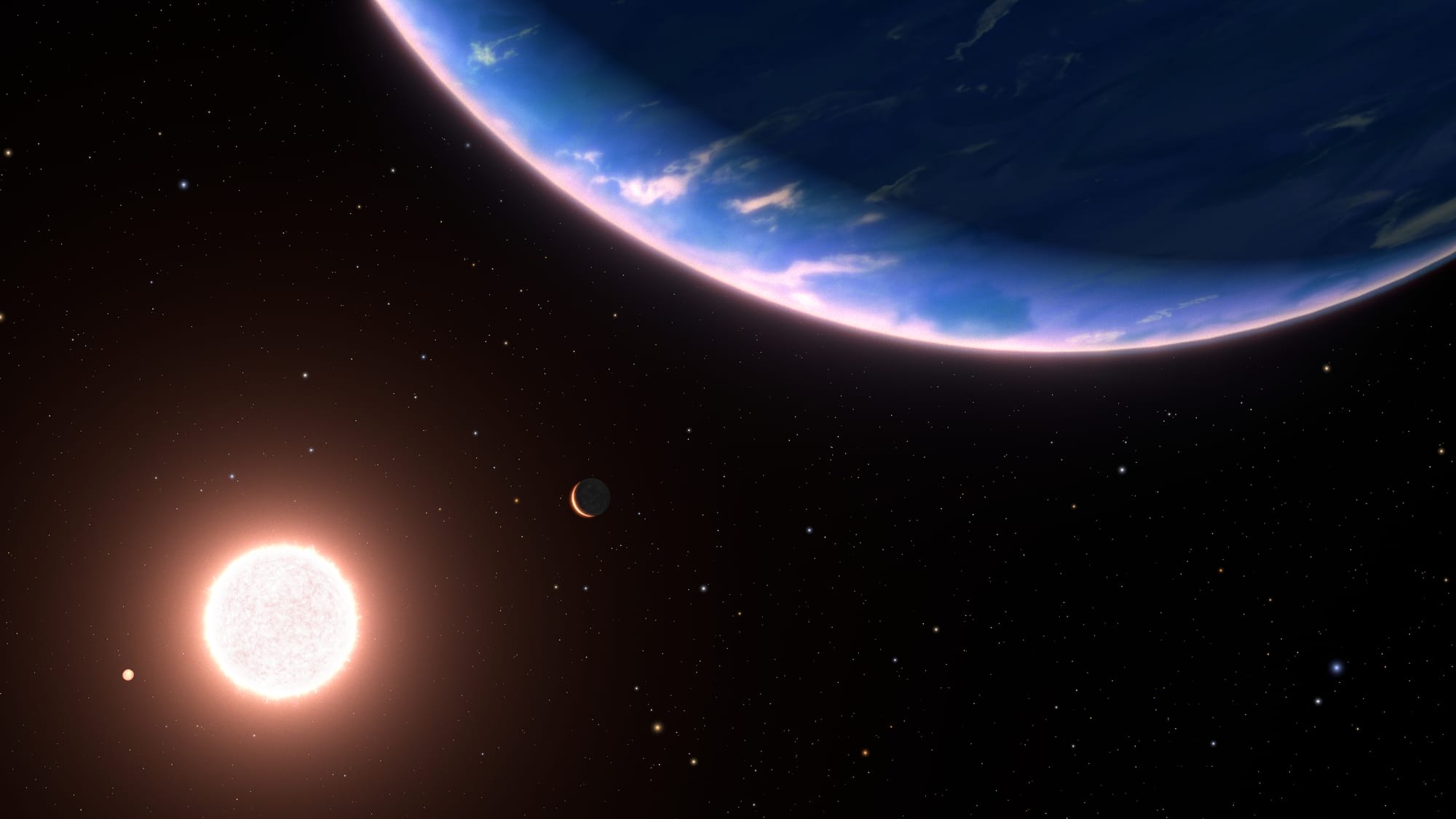
One of the study's most exciting findings is that many exoplanets orbiting red dwarfs—which are typically less than half as massive as the Sun—may be more likely to retain atmospheres than previously thought, though planets orbiting smallest and most active (flaring) red dwarfs remain a notable exception.
Red dwarfs are by far the most common type of stars in the galaxy, outnumbering Sun-like stars by as much as 20 to one. Dwarf stars also have much longer lifespans than larger stars, and could potentially shine for trillions of years, whereas the Sun is expected to tap out at a mere 10 billion years. Because of their abundance and longevity, these dwarf systems could provide plenty of time for life to emerge, though their potential habitability has been a matter of heated debate.
Given that LHS 1140-b orbits a red dwarf, these two new studies suggest that certain exoplanets orbiting dwarf stars may well retain atmospheres for billions of years, boosting the odds that they could host extraterrestrial life. Just like a real-life beach, the cosmic shoreline will continue to shift as new observations refine our knowledge of these distant worlds, their otherworldly skies, and the aliens that could potentially inhabit them.
That’s the file for this week—and for the rest of the summer! I am going to take the next month off from the newsletter for a much-needed break and to prepare some fun new stories for the fall. In the meantime, you can always catch my weekly reporting and newsletters at 404 Media. Feel free to send thoughts and suggestions for what you’d like to see more of in the BeX Files in the future at thebxfiles@gmail.com.
See you at the cosmic rest stop at summer’s end, and thanks for coming along for the ride.