Alien fireflies in the dark forest

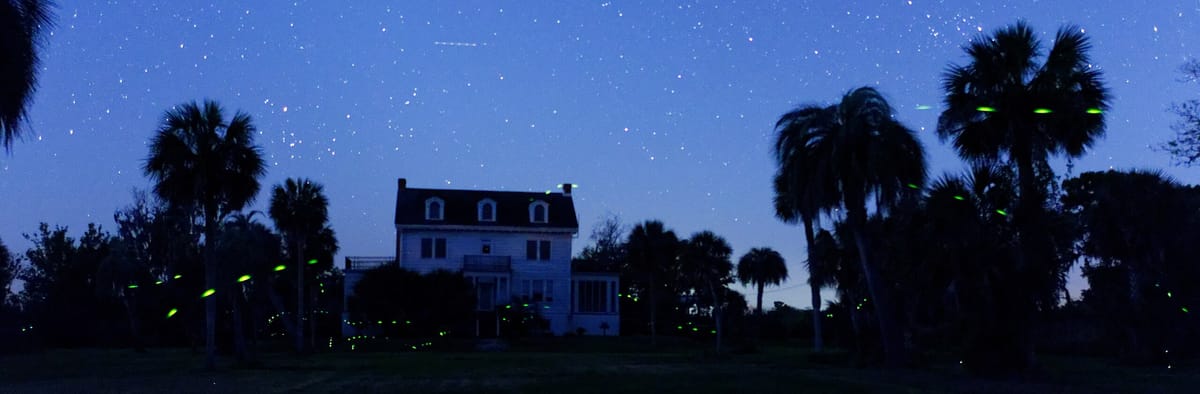
Thanks for tuning back into the BeX Files! Time to get lit (lit-erally) because this week’s file is about how fireflies can ~illuminate~ the search for extraterrestrial intelligence (SETI).
Humans have been trying to communicate with extraterrestrial beings since we learned to dream up sky deities and skinwalkers (obligatory book plug). As our technology has evolved, we’ve focused on finding analogs for it out there in the dark—radio messages, optical beacons, atmospheric pollution, or perhaps an alien’s version of NASA’s Voyager probes, floating through our solar system, loaded up with the sights and sounds of some far-off home.
But one of the most enchanting aspects of the search for aliens is imagining exotic and otherworldly perspectives on the universe—sort of like astral-projecting out of our anthropocentric assumptions. Fortunately, our planet is bursting at the seams with bizarre lifeforms that are ready-made inspiration; thus, the annals of SETI are filled with attempts to anticipate extraterrestrials by studying our fellow Earthlings.
Fireflies have now been added to this illustrious tradition, according to a preprint study from last November, which has not yet been peer-reviewed. Scientists led by Cameron Brooks of Arizona State University “present a firefly-inspired model for detecting potential technosignatures.”
 Cameron Brooks
Fireflies have evolved complex flash sequences that specifically signal to members of the same species, all while minimizing the risk of attracting the attention of predators. Brooks and his colleagues suggest that intelligent aliens might produce analogous transient signals, as opposed to sending out repeating messages designed to look as obvious as possible.
‘We build on the firefly communication model of Nguyen, Huang, and Peleg (2022), which simulates the evolution of firefly flash sequences over several generations, to examine how such signaling might influence the detectability of a ‘firefly-like’ ETI,” the team said. “The signal we evolve minimizes energy consumption, in the same way that firefly flash patterns maximize distinctiveness from other firefly species while minimizing predation risk.”
The study goes on to simulate how we might distinguish unique flashes from natural astrophysical phenomena such as pulsars, which are dead stars that pulse with clockwork rhythm. The authors don’t explicitly mention the Dark Forest hypothesis, a solution for the Fermi paradox that proposes we haven’t found aliens because they are too afraid to advertise their existence in a potentially hostile universe. But given the references to predator evasion, it came to mind.
Of course, it’s anyone’s guess whether firefly-like civilizations sparkle in a dark-forest sky, though it’s a cool idea. The team describes their work as a “thought experiment” that aims to “reduce anthropocentric bias by drawing on different communicative strategies observed within Earth’s biosphere.”
Maybe it’s just because the long midwinter has made me yearn for firefly season, but there’s something appealing about the thought that alien life might reveal itself not through loud cosmic foghorns or carefully crafted messages, but with simple fleeting signals—a one-off “here we are”—visible only to those who know how to look.
And with that, we’ll close the file for the week, Shine on, friends! See you at the cosmic rest stop next week.