The allure of alien geysers

Thanks for tuning back into the BeX Files! Pack your space-swimsuit and get ready to splash, because this week we’re running through some extraterrestrial sprinklers.
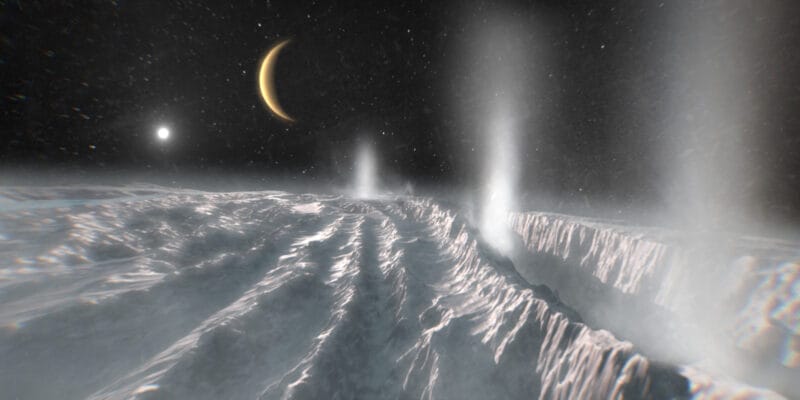
There are worlds in our solar system, like Saturn’s moon Enceladus and Neptune's moon Triton, that are constantly squirting alien seawater into space through geysers on their icy surfaces. Allow me to gush about these eruptions, because they present an exciting opportunity to taste the mist of otherworldly oceans—which could (pretty please?) contain traces of alien life.
NASA’s Cassini orbiter flew through the plumes of Enceladus about a decade ago, proving that this type of maneuver is possible, but that mission wasn’t designed to detect life. Why haven’t we launched any follow-up mission to reach for this low-hanging astrobiological fruit at Enceladus, or even further out at Triton? I don’t know. The question haunts me practically every day. But on the upside, NASA’s Europa Clipper, which is currently en route to Jupiter, may attempt to sample plumes of its namesake moon in the 2030s, if it can find them.
In the meantime, I am clearly not the only person getting fidgety about the possibility of intercepting space juice; a study out this week in Astrobiology explores the glamorously-named Crystal and Champagne geysers in Utah’s Green River as analogs of faraway fountains in space. Eruptions at these sites are driven by cold pressurized carbon-dioxide, rather than geothermal heat, which offers a glimpse of the cryovolcanic processes at work on some outer solar system moons.
“Plumes of ocean worlds, such as those of Enceladus, Triton, and possibly Europa, offer a unique opportunity to potentially access subsurface reservoirs without the need to dig, drill, or even land,” said researchers led by Morgan Cable of NASA Jet Propulsion Laboratory in the study.
“While no Earth-based system can perfectly replicate all the physical and chemical conditions of a different planetary environment, the chemical analyses reported here of two geysers at Green River, UT, may provide important constraints and other lessons on the abundance and detectability of habitability indicators in ocean world plume materials,” the team included.
Look, we’re all going so stir-crazy about the possibility of aliens that we are now chasing reverse waterfalls (my shorthand for geysers) here on Earth. The new study offers insights about how to search for biosignatures in the plumes of other worlds, assuming we do ever get to sample them. It was probably also a nice excuse to expense a trip to Utah’s beautiful wilderness.
Before closing the file for the week, I wanted to recommend a new article about UFOs by Michael Shermer in The Washington Post, a newspaper that is sadly being driven into the core of Earth by Jeff Bezos, who laid off more than 300 staffers this week.
Shermer has reported on UFOs, and UAP, for decades and reached the conclusion that “aliens are sky gods for skeptics, deities for atheists and a secular alternative to replace the rapidly declining religiosity in the West.” The replacement of celestial divinities with aliens is an interesting thesis that I explore a lot in First Contact, as I think much of the modern scientific search for aliens is clearly animated by mythological precursors.
That’s all for today. The BeX Files will be off for the next two weeks as I’m heading out to Phoenix for the annual meeting American Association for the Advancement of Science (AAAS), where I am eager to experience above-freezing temperatures for the first time in several weeks. See you at the cosmic rest stop at the end of the month!