Interstellar ghost ships on the horizon

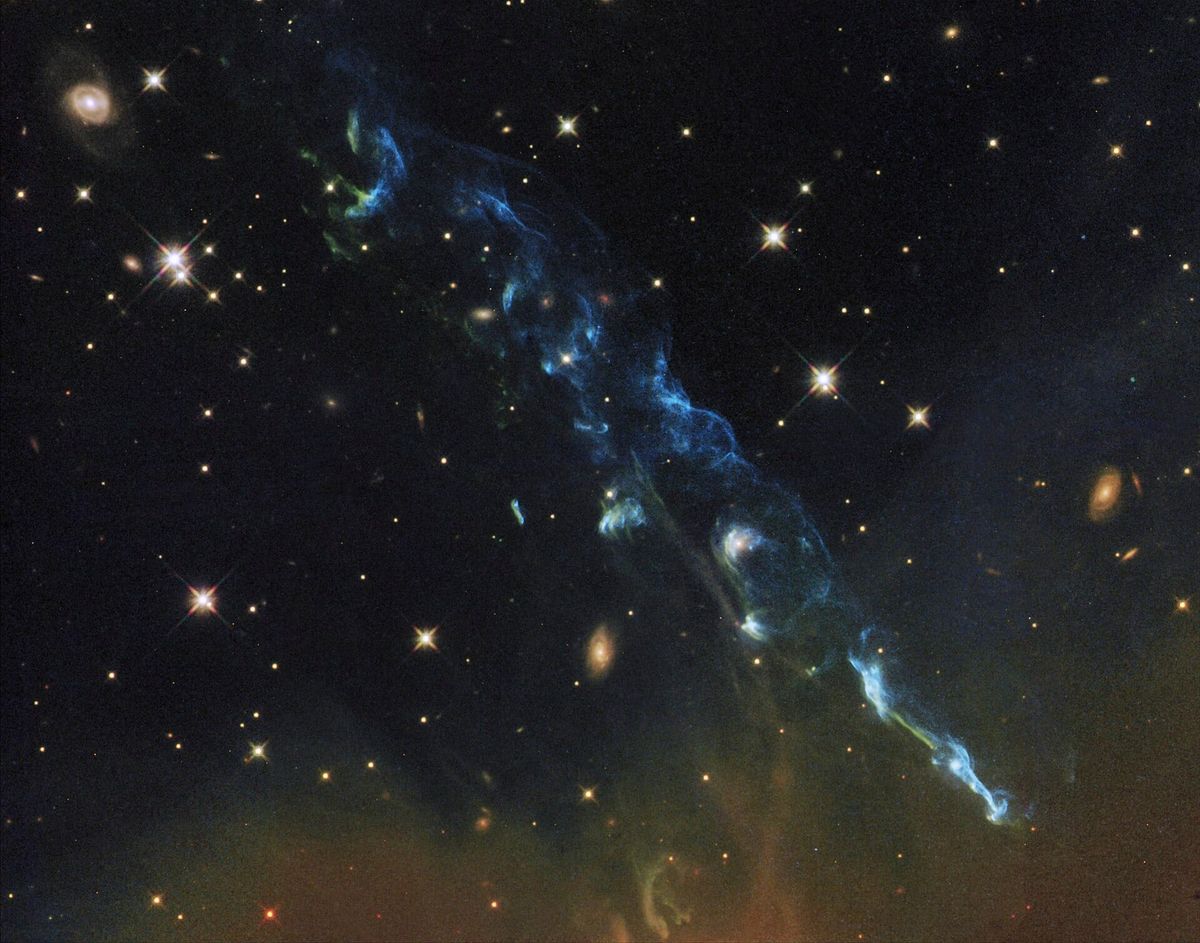
Thanks for tuning back into the BeX Files! Say goodbye to the solar system, because we are sailing the interstellar seas today.
For this week’s file, I wanted to highlight two unrelated studies that came this week about interstellar objects—only this time, they are homegrown.
Interstellar objects have become a topic of immense fascination and controversy since the discovery of the inaugural oddball 1I/ʻOumuamua in 2017, followed by the comets 2I/Borisov in 2019 and 3I/ATLAS in 2025.
These objects all hail from unknown star systems beyond the Sun, so it stands to reason that objects formed in our own solar system have also traversed interstellar space, wandering for eons and perhaps even passing through distant planetary neighborhoods along the way.
Scientists led by Lubos Neslušan of the Astronomical Institute of the Slovak Academy of Sciences have now explored this possibility in a study published on Tuesday in the journal Astronomy & Astrophysics entitled “Solar System material reaching neighboring star systems.”
 Full Guide (PDF file)
“The motion of the Sun through the galactic environment inevitably results in the presence of interstellar material in the Solar System,” the team said in the study. “In this work, we address the opposite scenario. Our aim is to determine whether material ejected from the Solar System can reach other stellar systems in the Sun’s vicinity.”
To constrain this mystery, the team combed through the CNS5 catalog of neighboring stars and the CODE catalog of future orbits of comets to predict how much ejected material from our solar system might rendezvous with other stars and exoplanets. It turns out that only a very small amount of homegrown debris is likely to encounter other systems, though the researchers emphasized that there are still huge uncertainties inherent to this question.

Even so, this study (and future iterations) may have implications for the idea of interstellar panspermia, which posits that life might be able to travel between star systems.
“Our results indicate that only a tiny amount of material from the Solar System can be delivered in the close vicinity of other stars, even over relatively long timescales,” the team concluded. “Since the quantity is not zero, it allows for speculation that prebiotic material could be transferred to exoplanetary systems, potentially affecting the emergence of life.”
While it’s hard to know how much local detritus is reaching other systems, we do know a lot about another class of interstellar object—the robots we’ve sent to sail the interstellar seas.
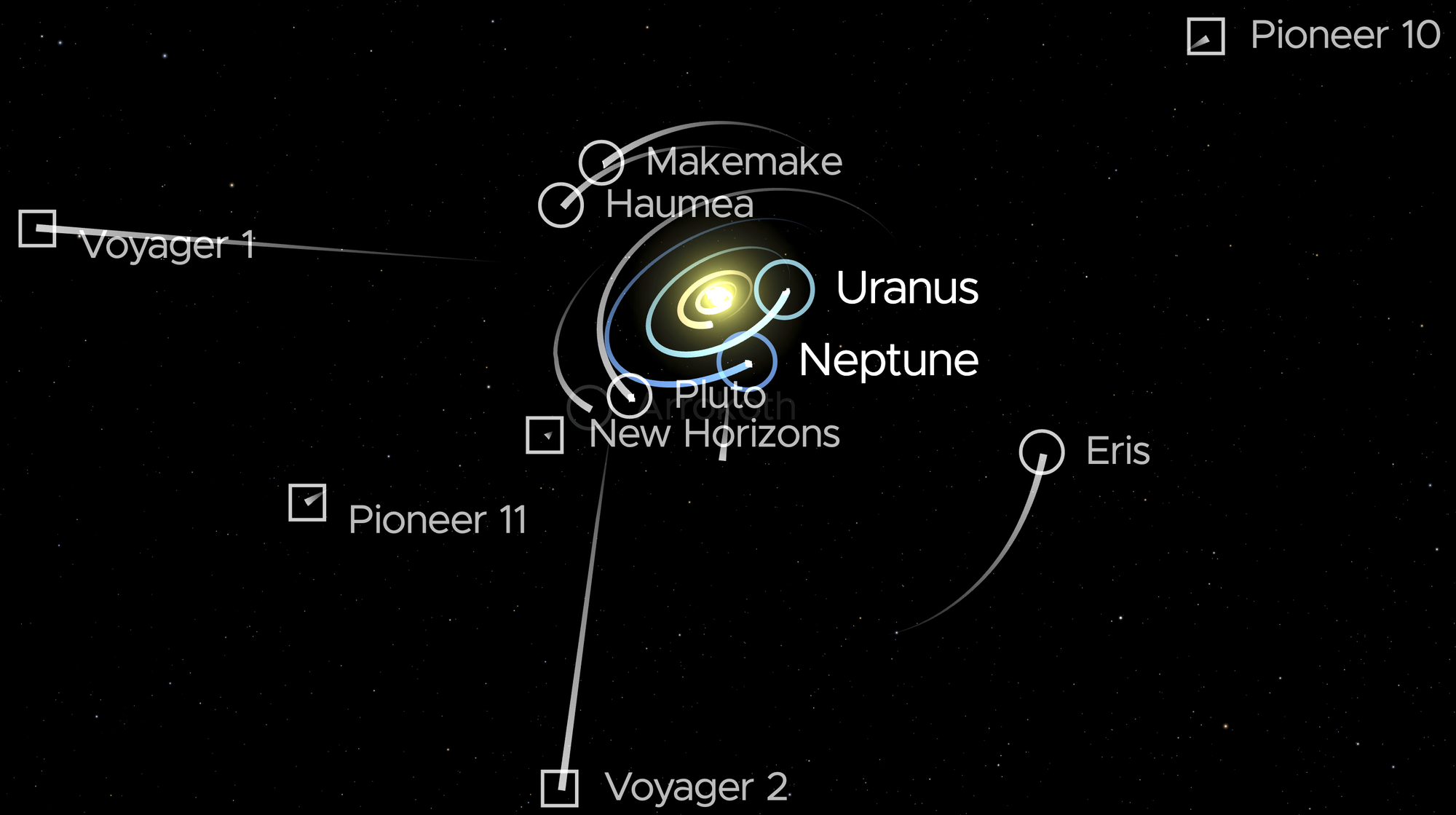
So far, Voyager 1 and 2, launched in 1977, are the only spacecraft that we know have crossed into interstellar space, a feat they achieved in 2012 and 2018 respectively. Both probes are still chattering away and sending back dispatches from this frontier, nearly 50 years after their departure from Earth.
Pioneer 10 and 11, launched in 1972 and 1973, are also bound for interstellar space, but they are both “ghost ships” that have ceased communication with Earth, so their whereabouts are unknown.
That leaves one last active probe—New Horizons, launched in 2006, which is approaching interstellar space, more than a decade after its spectacular 2015 flyby of Pluto.
Scientists led by Jonathan Gasser of the Southwest Research Institute provided an update on this spacecraft’s journey in a study published on Wednesday in Advances in Space Research entitled, “Predictions of New Horizons’ Termination Shock Crossing.”
 Alicia Cermak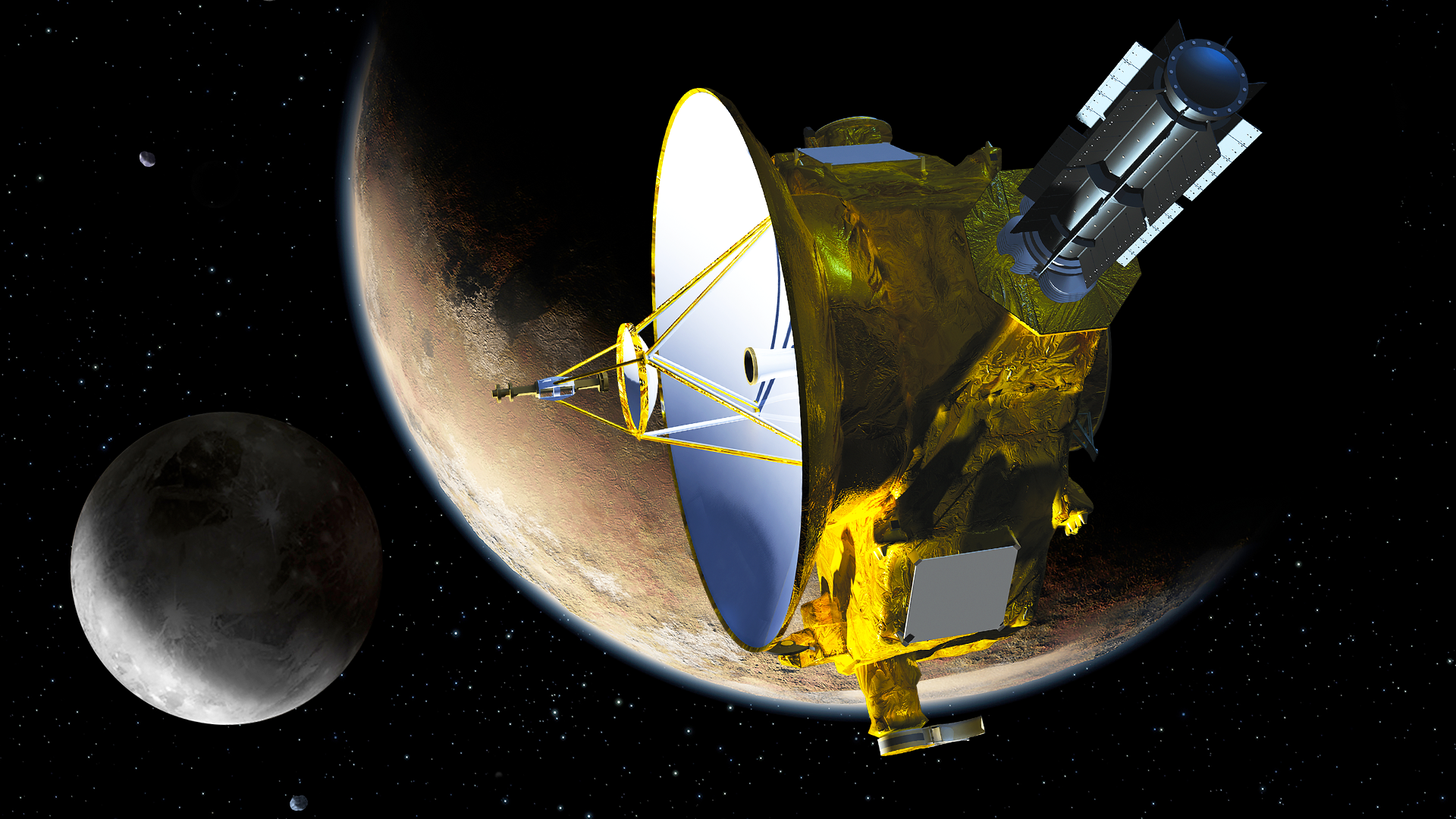
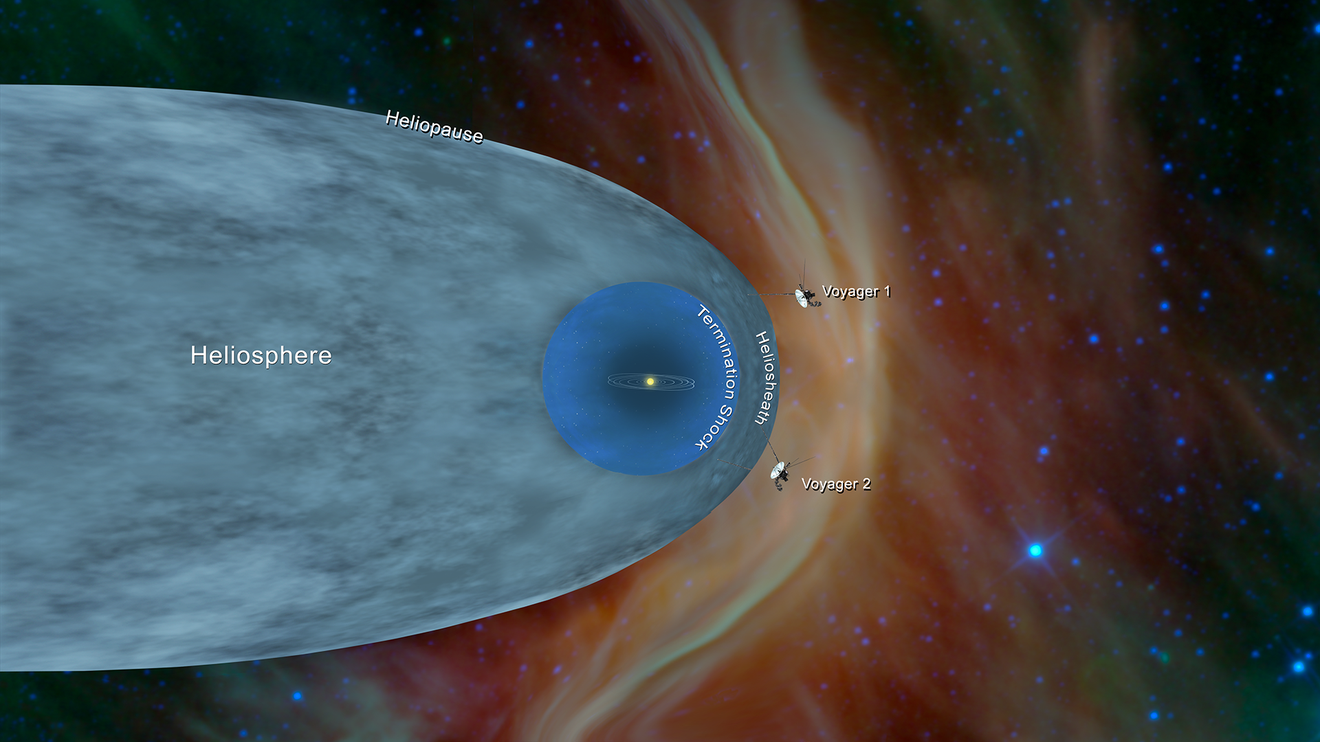
The team predicted that New Horizons is getting close to the “termination shock,” a region about eight billion miles from Earth where the supersonic solar wind slows down to subsonic speeds as it meets the local interstellar medium. The probe will hit this zone anywhere between 2029 and the 2040s, according to the study. After breaching this boundary, it will make its way beyond the heliosphere—the immense bubble created by the solar wind—and join its predecessors in interstellar space, likely by 2050.
“The New Horizons spacecraft is en route to cross the termination shock as it traverses the outer reaches of our solar system and will eventually leave the heliosphere and enter interstellar space,” the team said in the study. “It is currently the only operational mission in the outer heliosphere and is equipped with instrumentation allowing it to study the heliospheric boundaries.”
It will be exciting to follow New Horizons through its next great adventure, assuming that it remains operational and able to send back dispatches. By the time it reaches interstellar space, we will have probably lost contact with it, as well as the long-lived Voyagers.
Given that there are no interstellar probes following in the footsteps (or antenna-steps?) of these trailblazers, this trio of incredible missions are likely to provide the last direct observations of this distant gateway that we will see in our lifetimes. There will come a day when each of these spacecraft sends its very last dispatch home. But we will always be able to look into space and know that they are there, out in the galactic wilderness—a message to the broader universe that we were here.
That’s the file for today! Hope it inspired some yearning for new horizons (heh) as well as an appreciation for the lush haven we enjoy here in our home world.
To that point, happy belated Earth Day to all who observe! And see you at the cosmic rest stop next week.