A bento box of biosignatures


Thanks for tuning back into the BeX Files! This week, we’re exploring one of the biggest mysteries in science: What the heck even is life anyway? Answering this question here on Earth is kind of important if we hope to find alien life elsewhere in the universe.
There are many frameworks for how to distinguish a living thing from non-living material: Life can be defined as a self-replicating chemical system subject to natural selection, or a type of molecular machinery with a self-sustaining structure distinct from abiotic matter. In more general terms, life is defined as: we’ll know it when we see it.
But that’s not always an easy threshold to recognize in practice. There are many ancient and complex structures on our planet that seem to fall somewhere on the gradient between non-living and living. These vagaries have inspired a host of clever approaches in the search for alien biosignatures beyond Earth.
To that end, I have put together a little biosignature bento box containing a bunch of new thought-provoking works that riff on this problem.
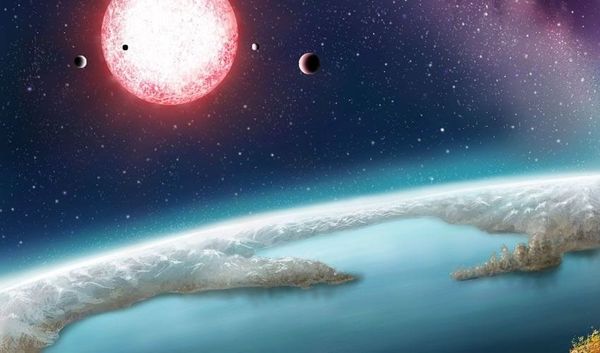
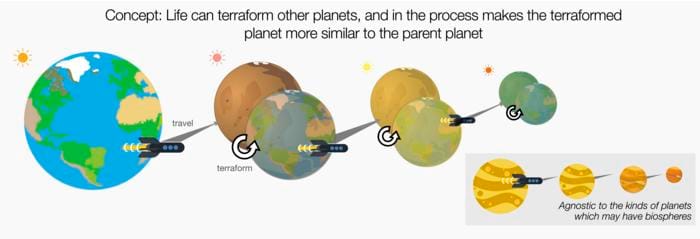
First, a study published last month in The Astrophysical Journal argues for a “numbers game” strategy for finding biosignatures in the skies of distant exoplanets. By assessing larger samples of exoplanets, scientists could spot signs that aliens are colonizing and terraforming multiple worlds, or even star systems.
 Harrison B. Smith
“Here we ask, can we detect the presence of life if we postulate that life is spreading between and terraforming planets?” write Harrison Smith of Earth-Life Science Institute (ELSI) at Institute of Science Tokyo and Lana Sinapayen of Japan’s National Institute for Basic Biology, in the study.
“If life can spread between star systems and affect the observable properties of a planet, then a robust signature of life (with very few false positives) can emerge, defined by correlations between planet characteristics and their locations,” they add.
A second study, published this week in The International Journal of Astrobiology, presents a more abstract critique of life as a simple binary. The authors offer a new sliding scale of biosignature assessment based on “temporal retention of information,” meaning systems that mark “the passing of time through changes in the inter-generational transfer of information.”
Terence Phillip Kee
“Instead of the binary distinction of life/non-life that causes both severe philosophical difficulties of definition and practical difficulties of detection, one could imagine instead defining a spectrum of livingness in terms of an informational correlate,” write authors Terence Phillip Kee of the University of Leeds and James McCrum of the University of York, in the study.
This might lead to “a broader and more comprehensive understanding of what life is without ever having to have left Earth itself,” they add.
 Olivia Harper Wilkins, The Conversation
Next, I wanted to spotlight a thoughtful new article about biosignatures by Olivia Harper Wilkins, an astrochemist at Dickinson College. Wilkins outlines some of the most tantalizing news about possible alien biosignatures—and throws some refreshing cold water on them.
While “there is a lot to be excited about…this excitement can be premature,” she writes. “Finding molecules in places people will likely never visit is no simple task, so vetting and sometimes correcting these observations is a continual process.”
Last, just for fun, here's a new preprint study (meaning it hasn't been peer-reviewed) about sending a swarm of tiny spacecraft to the nearest known exoplanets—including Proxima b, located four light years away—to look for alien life.
T. Marshall Eubanks
"A near-relativistic swarm mission could provide a strong initial survey of Proxima b as an exoplanet and should be able to detect Proxima b biosignatures and technosignatures, should these be present," writes a team led by T. Marshall Eubanks of Space Initiatives Inc.
"With this technology it should also be possible to perform in this century in situ exploration by swarms of small spacecraft of the entire Alpha Centauri system together with the Barnard’s Star, Wolf 359 and Lalande 21185 systems, some brown dwarf systems such Luhman 16, and any nearby nomadic planets," the researchers add.
To sum up, we’re lucky to live in an age when possible signs of life—from Mars to distant exoplanets—can feasibly be detected at all. But as the above scientists remind us, it will take patience and relentless scrutiny to separate the alien wheat from the abiotic chaff.
That's the file for today! See you at the cosmic rest stop next Friday.