Stellar occultations, alien artifacts, & solstices, oh my

Thanks for tuning back into the BeX Files! Break out the backyard telescope, because we are chasing the cosmic shadows this week.
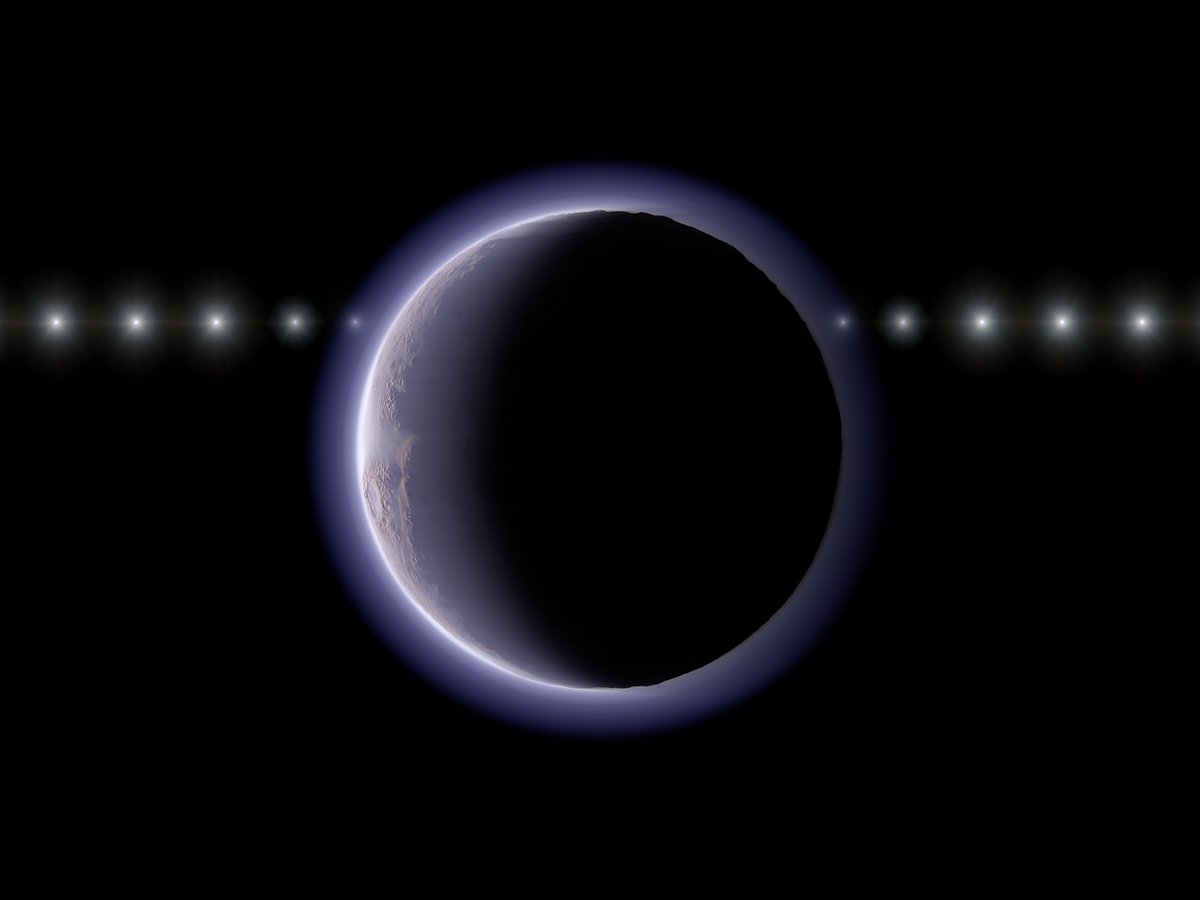
For years, I’ve been flagging stories about stellar occultations, which are tiny eclipses that occur when solar system objects pass in front of background stars. I was excited to finally do a deep dive on this emerging field for Supercluster, which came out earlier this month.


Astronomers have capitalized on occultations for thousands of years; many ancient cultures used occultations to fine-tune lunar calendars and track other celestial patterns. As telescopes improved over the 20th century, scientists were able to use these transient events to study small solar system objects; for instance, the rings of Uranus were discovered during a stellar occultation in 1977.
But now, the field is entering a new era of precision with regard to predicting these fleeting alignments, which expose unprecedented details about mysterious bodies—including their moon and ring systems, atmospheres, and shapes. Stellar occultations are a particularly powerful probe of icy worlds beyond the orbit of Neptune, known as trans-Neptunian objects (TNO).
In addition to their growing role in academic astronomy, amateur skywatchers are increasingly involved in this research, especially if they happen to live in the shadowy path of an occultation and can contribute observations.
“I think citizen scientists will continue to play a very important role,” Ko Arimatsu, an astronomer at the National Astronomical Observatory of Japan, told me. “In stellar occultations, the shadow path can be narrow, so having many observers at different locations can be scientifically crucial. A small telescope in the right place can sometimes provide information that a large telescope elsewhere cannot.”
 Ko Arimatsu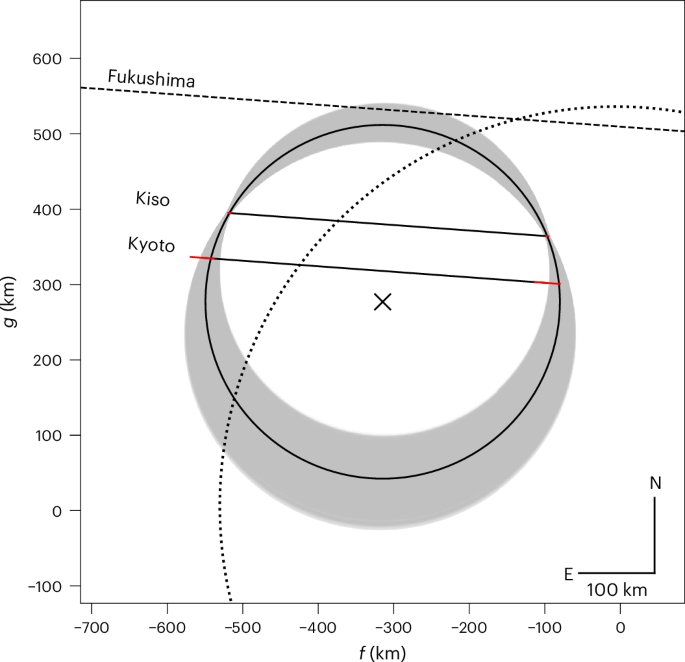
Arimatsu’s team recently reported the surprise discovery of a thin atmosphere around a small “plutino”—a relative of Pluto—called 2002 XV93 with the help of a citizen scientist who was in the path of an occultation.
Meanwhile, José Luis Ortiz, a research scientist at Instituto de Astrofísica de Andalucía, recently led a record-breaking campaign to observe a stellar occultation of Haumea, a bizarre dwarf planet, that occurred on May 4, 2026.
“More than 140 observing sites participated in the campaign” for the May 4 occultation, Ortiz told me. May the Fourth be with us, indeed!
Ortiz added that “the best tool that we have for the study of TNOs at very high spatial resolution is stellar occultations” and that “no other technique except a space mission can achieve better results.”
“I expect stellar occultation techniques to keep improving the sensitivity to thin atmospheres, rings, and other structures around small Solar System bodies,” Arimatsu told me. “This approach is especially powerful for objects that are too distant and too small to resolve directly, even with large telescopes.”
I simply love to see a weird subfield undergoing rapid transformation. Watch this space.
Before closing the file for today, I wanted to share a fascinating preprint that recently hit the arXiv about the search for alien technosignatures in the solar system.
 T. Joseph W. Lazio
T. Joseph W. Lazio, a radio astronomer at NASA's Jet Propulsion Laboratory, presents the hypothesis that alien artifacts exist in the solar system and assesses whether current observations are capable of ruling it out. Because there are so many unknowns about solar system bodies, he concludes that “only extremely crude upper limits can be placed on the existence of technosignatures in the Solar System and that, in some cases, relatively large probes or surface artifacts would have escaped detection.”
“There is considerable discovery space remaining within the Solar System and that effective searches could be conducted with existing data sets or those to be acquired in the next few decades,” Lazio writes in the preprint, which has not been peer-reviewed. “Even if no ET physical technosignature is identified, investigating anomalies in those data sets likely will produce discoveries in astronomy and planetary science.”
So for all you aspiring extraterrestrial archaeologists out there, keep dreaming! There's still hope. For more on the search for alien artifacts, check out my recent WIRED article on the topic.
 Becky Ferreira
With that, I’m wishing my fellow Northern Earthlings a bright summer solstice, and a cozy winter solstice to the South-side crew. See you at the cosmic rest stop next week!