Planets—bet you can't eat just one

Thanks for tuning back into the BeX Files! Set the table and bring an appetite, because we are serving up planets today.
In my last dispatch from June, I wrote about the mind-boggling phenomenon of planetary engulfment, which is the term that describes when stars straight-up devour their planets. The topic was on my mind in part because I have been working on an article about one of these world-munching stars for The New York Times, which came out yesterday.
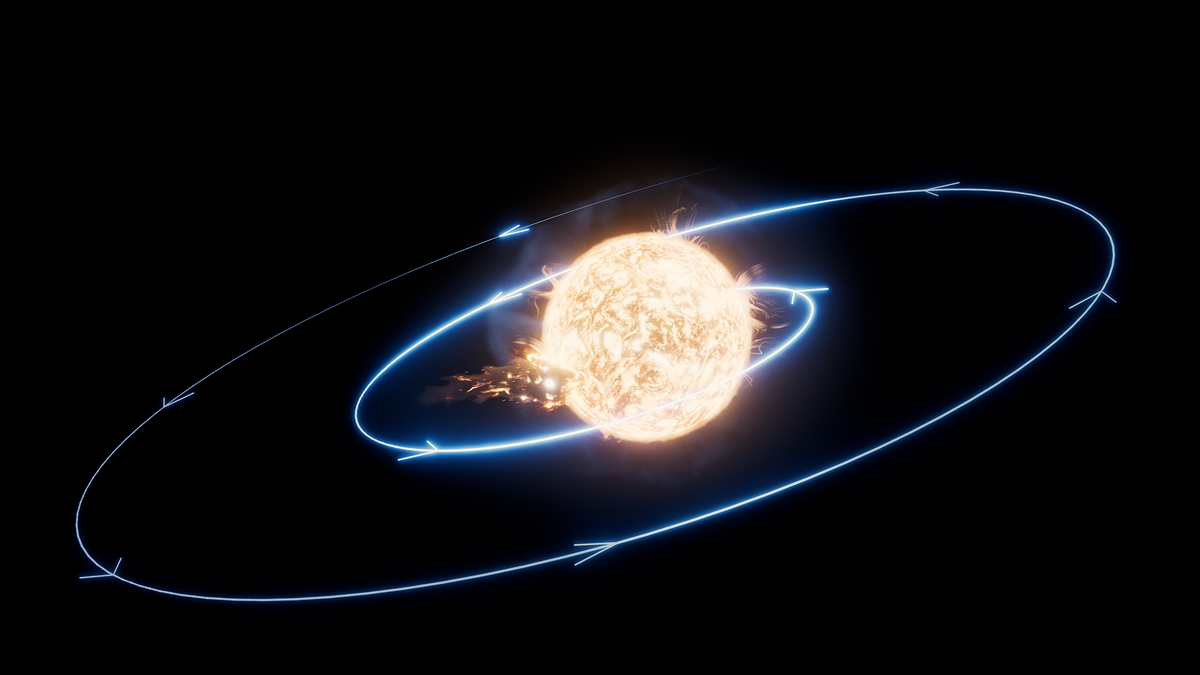
The star in question, known as TOI-5882, has likely already eaten one of its planets—and it’s gearing up for a big second helping, according to a pair of studies. That’s right: A multi-course planetary meal is underway in this system, making it a perfect candidate for unraveling some of the mysteries of planetary engulfment.
TOI-5882, which is about 30 percent more massive than the Sun and is located some 1,300 light years from Earth, piqued the interest of astronomers in part because it is closely orbited by a gargantuan celestial object known as a “brown dwarf,” which is roughly 22 times more massive than Jupiter.
When astronomers analyzed the spectrum of TOI-5882, they found large stores of lithium, an element that is far more common in planets than in stars. After considering several explanations, the team concluded that the most likely source was a planet—possibly a “super-Earth” or Neptune-mass world—that was consumed by the star sometime in the past few billion years.
But how did the planet get served up to the star? That’s where the brown dwarf comes in. The gravitational heft of this huge object could easily disrupt a neighboring planet and send it hurtling to its infernal doom inside the star.
That’s what the authors of one study think likely happened. But the brown dwarf will not get off scot-free, according to a second study. Because of its close orbit, this colossal world is guaranteed to be engulfed by its star in the future—and rather soon, in cosmic terms. By running updated models of the dynamics between stars and planets, the study authors estimated that the brown dwarf will be star toast in about 25 million years.
It’s an incredible tale of a hungry star, its half-digested appetizer, and its upcoming entrée. Bon appétit!
I love the planetary engulfment beat and have written about it many times before. Some readers alerted me to a formatting error in my previous file: The articles I embedded did not display in the emailed newsletter. Here are the links if you'd like to know more about catching engulfments in flagrante, a planet that escaped engulfment, and how scientists search for these “cannibal stars.”
I also wanted to end with a stray morsel that didn’t make the cut for the most recent article. Lorenzo Spina, an astrophysicist at the Astronomical Observatory of Padua who studies planetary engulfment, told me that these events offer an unprecedented glimpse of the innards of exoplanets. Though telescopes can spot chemicals in the skies of distant worlds, stars that have swallowed planets emit light imprinted with the chemical signatures of those digested worlds, exposing their bulk compositions. There is no other way to get a look at planet guts from afar.
One day, Spina hopes that we will be able to identify the engulfed remains of exoplanets in stars that hail from beyond the Milky Way and that have migrated between galaxies.
“Imagine that you see these kinds of signatures in these stars—it would imply that you will be able to know, or at least to have a rough idea of the chemical pattern or makeup of planets that formed in other galaxies,” Spina told me. “These planets may be completely different from the planets that we know.”
Food for thought! That’s the file for today. See you at the cosmic rest stop next week.